KOTI Insight

RESEARCH
KOTI - Korea Transport institute
KOTI Insight Vol.1 No.4
- Date
December 31 2025
- Authors
임서현
- Page(s)
11 page(s)

Enhancing the Effectiveness of Transportation Policy Implementation to Address Low Fertility
Seohyun Lim
KEY SUMMARY
As persistently low fertility continues over a prolonged period, creating an “environment in which it is easy to have and raise children” has emerged as a national-level priority. In this context, transportation policy functions not as a single instrument that directly increases fertility rates in the short term, but rather as a core infrastructure that stabilizes daily living conditions by alleviating recurring mobility inconveniences and cost burdens throughout pregnancy, childbirth, and childrearing. Survey results show that private vehicle use accounts for a very high share (87.7%) of routine travel among policy target groups, indicating that it is difficult to secure sufficient perceived policy effects through public transportation-centered approaches alone, and suggesting that improvements in everyday transportation quality―such as parking, boarding and alighting convenience, stroller-accessible movement paths, and transfer convenience―must be pursued in parallel.
In addition, policy effectiveness was found to depend more on whether delivery systems function effectively―enabling users to recognize, apply for, and utilize policies―than on the mere existence of the 制度 programs themselves. For example, awareness of transportation cost and mobility support policies was low at 23.0%, and actual utilization experience was also generally limited, confirming that bottlenecks occur at the stages of information access, eligibility verification, and application despite the presence of policy demand. Accordingly, an Importance-Performance Analysis (IPA) was conducted to identify policy areas requiring improvement, and the results of an expert Analytic Hierarchy Process (AHP) analysis showed that “policy effectiveness” received the highest weight (0.453) among policy implementation criteria, indicating that perceived outcomes should be the primary basis for decision-making when setting policy priorities.
Taken together, these findings suggest that enhancing the effectiveness of transportation support policies for addressing low fertility should focus on increasing “usability” rather than simply expanding new programs. Specifically, this includes procedural innovations such as integrated applications, automatic enrollment, and automatic renewal, strengthening accessibility through alternative modes such as taxis and demand-responsive transport (DRT) that reflect local conditions, simplifying 制度 structures for fare discounts, reimbursements, and direct transportation cost support, improving the quality of family-friendly and barrier-free facilities, and enhancing information delivery systems by combining one-stop guidance at hospitals and public health centers with digital notifications as key improvement tasks. Ultimately, the objective of policy should not be limited to the establishment of 制度 frameworks, but should also involve refining delivery systems and operational methods so that actual use and perceived benefits can be verified in citizens’ everyday lives.
Note: This manuscript is based on the research report titled “Identifying Transportation Policies to Address Low Fertility and Enhancing the
Effectiveness of Their Implementation,” conducted in 2025 as an institutional research project of The Korea Transport Institute.
01 Research Overview
As low fertility persists over the long term, the factors hindering childbirth and childrearing have expanded beyond childcare and housing to include mobility inconveniences and cost burdens across daily activities, such as hospital visits, travel to childcare facilities, school commuting, and routine outings. The reality that the total fertility rate remains at approximately 0.75 in 2024 demonstrates the need for policies to move beyond fragmented support and become more refined toward stabilizing everyday living conditions.
Accordingly, this study views transportation policy not as a “single instrument that directly increases fertility rates,” but as foundational infrastructure that supports a child-rearing-friendly environment by alleviating recurring mobility burdens throughout pregnancy, childbirth, and childrearing, and seeks to assess the effectiveness of transportation support policies and propose directions for improvement from a lowfertilityresponse perspective. Although transportation support policies targeting pregnant women and households with children have been partially introduced and expanded in practice, there is insufficient evidence to comprehensively compare and verify perceived impacts, effectiveness by policy type, and the functioning of delivery systems, resulting in a weak basis for policy judgment regarding what should be prioritized and how such policies should be scaled up, which forms the background of this study. Therefore, the objective of this study is to connect the identification, evaluation, prioritization, and dissemination strategies of transportation policies for responding to low fertility into a single continuum, and to provide evidence that enables the central government and local governments to design implementable policy packages and expand them in a phased manner.
The study reviewed policies with a focus on mobility constraints and levels of perceived policy impact experienced by households preparing for pregnancy, pregnant women, households with infants, young children, and elementary school-aged children, as well as multi-child households (with two or more children).
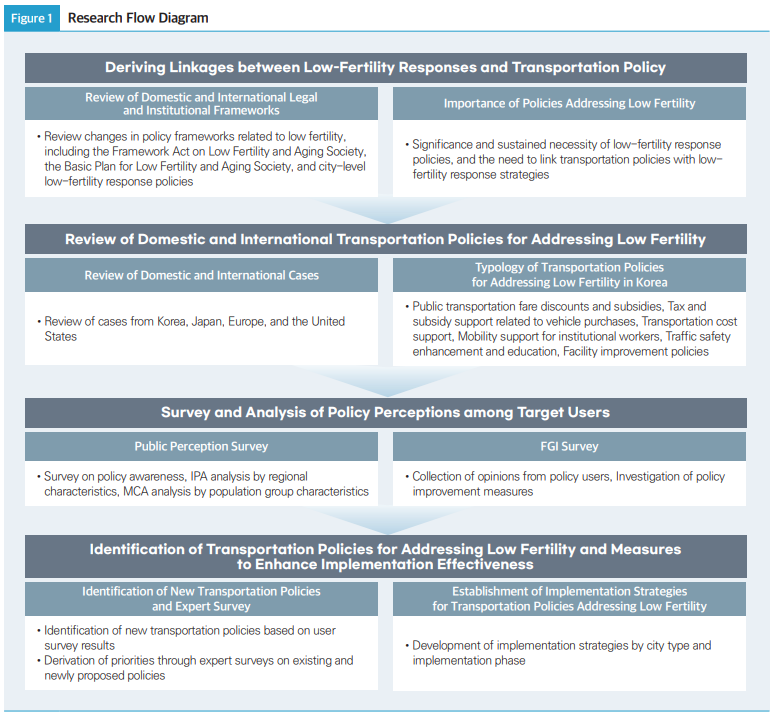
The substantive scope of the study consists of: (1) organizing the linkage between lowfertilityresponses and transportation policy; (2) reviewing and categorizing domestic and international transportation support policies; (3) analyzing perceived impacts and bottleneck factors through public perception surveys and focus group interviews (FGIs); and (4)deriving priorities and proposing implementation strategies through expert evaluation.
It is expected that the results of this study will be utilized not merely for the “identification of new” transportation support policies for addressing low fertility, but also for setting priorities, designing policy packages tailored to regional conditions, improving delivery systems (such as integrated applications and automatic enrollment), establishing performance indicators, and designing pilot projects to enhance perceived effectiveness within the everyday contexts of policy target groups.
"This study provides an integrated framework for identifying, evaluating, prioritizing, and scaling transportation policies addressing low fertility, offering practical evidence to support policy package design and phased implementation by national and local governments."
02 Research Methodology
This study was conducted through a process that organizes the current status of transportation support policies for addressing low fertility, examines user experiences, and connects these findings to policy prioritization and implementation strategies, so that such policies do not remain at the level of “制度 establishment” but lead to actual use and perceived benefits. Through a literature review, the necessity of linking lowfertilityresponses with transportation policy was clarified, and domestic implementation policies were categorized based on domestic and international cases to establish an analytical framework for subsequent surveys and evaluations. Next, an online survey (May 16-20, 2025; n=522) was conducted targeting newly married couples, pregnant women,
and households with infants, young children, and elementary school-aged children aged 19-49, and was designed to quantitatively identify not only “what is needed” but also “why perceived impacts are low” by jointly examining travel behavior, policy awareness and utilization experience, importance and satisfaction, and the need for expansion.
The survey results were extended through an Importance-Performance Analysis (IPA) to distinguish policy areas requiring maintenance or improvement and to clearly identify targets for enhancement. To supplement limitations that are difficult to explain solely through quantitative survey results, a focus group interview (FGI; June 4, 2025) was conducted to concretize inconveniences in the application and utilization processes and bottlenecks in information access, and to identify underlying causes within everyday life contexts. Finally, to clarify decision-making criteria for policy implementation and determine the order of execution, an expert survey was conducted to analyze the importance of policy effectiveness, social impact, equity and accessibility, budget feasibility, and sustainability, and the research framework was structured to utilize these results in deriving policy priorities. This approach was designed to be applicable to policy prioritization, region-specific policy package design, delivery system improvements, and the formulation of implementation strategies and roadmaps by sequentially linking userperceivedimpacts (survey and IPA), on-the-ground causes (FGI), and decision-making from a policy implementation perspective (AHP).
03 Survey and Analysis of Perceived Impacts of Transportation Policies for Addressing Low Fertility
In this chapter, the study sequentially examines “what the actual mobility conditions of policy target groups are (03-1),” “to what extent policies are known and perceived (03-2),” “what should be maintained or improved (03-3),” and “what should be implemented first (03-4)” in order to enhance the effectiveness of transportation policies for addressing low fertility. In this process, the study linked user surveys and Importance-Performance Analysis (IPA), focus group interviews (FGIs), and expert Analytic Hierarchy Process (AHP) results to derive priorities for policy improvement and region-specific implementation directions.
Mobility Conditions to Be Considered in Transportation Policy
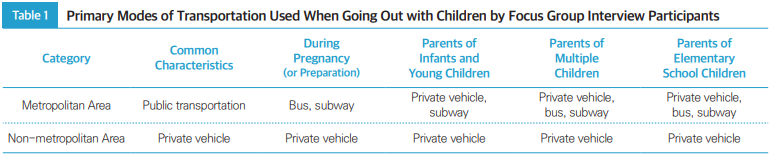
The online survey conducted in this study (May 16-20, 2025; n=522) was designed to first identify the daily mobility conditions of newly married couples, pregnant women, and households with infants, young children, and elementary school-aged children, who are the primary targets of low-fertility response policies. The analysis showed that the proportion of vehicle owners who drive themselves was high at 86.5%. In addition, based on routine travel, the survey confirmed that the most frequently used mode of transportation among respondents was private vehicles (87.7%). A private vehicleorientedpattern was also maintained for trips made with children, with private vehicles identified as the primary mode of travel, accounting for 88.1% of daily life trips and 90.0% of interregional trips. Furthermore, the higher dependence on private vehicle travel in non-metropolitan areas compared to the metropolitan region suggests that transportation policies for addressing low fertility have difficulty generating perceived outcomes through public transportation-centered support alone. This indicates the need to simultaneously consider improvements in everyday transportation quality, including parking, boarding and alighting convenience, stroller movement paths, and transfer burdens that households with pregnant women and young children repeatedly experience in daily life.
Policy Awareness and Gaps in Perceived Impact
This study did not merely examine the existence of policies, but measured policy awareness, utilization experience, importance, satisfaction, and the need for expansion through survey questions in order to identify “points at which policies fail to function in practice.” The analysis showed that awareness of transportation cost and mobility support policies was low at 23.0%, and utilization experience was also generally limited, including direct transportation cost support (13.4%), fare subsidies for taxis and similar services (9.8%), and alternative mobility services (8.2%). In contrast, the study confirmed that awareness of policies aimed at improving family-friendly environments within transportation facilities was relatively high at 62.6%. The study did not interpret these differences solely as variations in policy content, but examined the possibility of bottlenecks in the process through which policies are delivered to users. In the focus group interview conducted for this purpose (FGI, June 4, 2025), participants repeatedly emphasized the need for a system that enables one-time guidance and application for relevant policies at the point when pregnancy is confirmed,and it was particularly confirmed that official information channels are insufficient in non-metropolitan areas. These findings indicate that the reduced perceived impact of transportation policies for addressing low fertility may be more closely related to issues in policy operation and delivery systems―arising during information dissemination, eligibility verification, and application procedures―than to the mere existence of the policies themselves.

What Should Be Maintained and What Should Be Improved (Importance-Performance Analysis, IPA)
This study conducted an Importance-Performance Analysis (IPA) using the importance and satisfaction values derived from the survey. IPA is used to diagnose the current performance of each transportation policy for addressing low fertility based on importance and satisfaction, and to assess directions for improvement by classifying policies into areas such as priority setting, maintenance areas, and key improvement areas. The IPA results identified transportation cost and mobility support, as well as mobility support for workers in childcare and caregiving service institutions, as “key improvement areas (high importance and low satisfaction).” In other words, the study used data to identify areas that users consider important but are not satisfied with, and suggested that these areas should be prioritized for improvement.
The study interpreted that transportation support policies for addressing low fertility should not be applied uniformly nationwide, but instead require policy package designs that reflect regional conditions, such as differences between large cities and small and medium-sized cities. When examining the results analyzed by distinguishing between large cities and small and medium-sized cities, the maintenance areas were found to be the same as those identified in the overall policy analysis, whereas no policies were identified as key improvement areas for small and medium-sized cities. In addition, for the gradual improvement areas, the same items were identified for both the overall analysis and large cities, but for small and medium-sized cities, (4) transportation cost and mobility support policies targeting households with pregnant women, infants and young children, and multi-child households, and (5) mobility support policies for workers in institutions providing childcare and caregiving services were additionally identified.
Finally, in the sustained management area, only small and medium-sized cities identified (2) tax and subsidy support policies related to vehicle purchases for multi-child households.
"Rather than applying transportation support policies for low fertility uniformly nationwide, it is necessary to design tailored policy packages that consider local conditions specific to metropolitan and small-to-mediumsized cities."

What Should Be Implemented First?
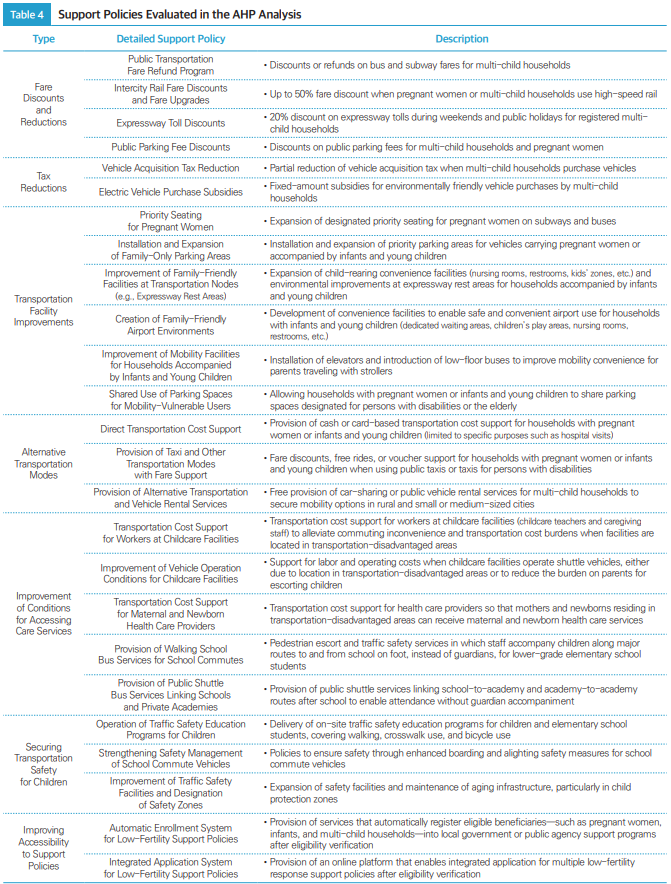
To translate the improvement areas identified through the IPA into an actual sequence of policy implementation, this study conducted an expert AHP survey (August 8-14, 2025). The survey was conducted to derive policy priorities by calculating weights for evaluation criteria―such as policy effectiveness, social impact, equity and accessibility, and sustainability of budget financing―using the Analytic Hierarchy Process (AHP) method.
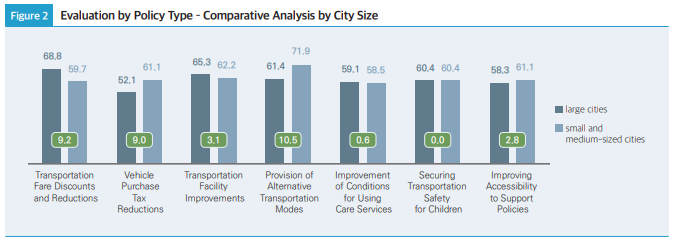
The AHP analysis showed that among policy evaluation criteria, policy effectiveness had the highest weight at 0.453, followed by social impact (0.224) and budget financing (0.165). These results provide evidence that policy prioritization should be based on actual effectiveness and scalability rather than policy intent alone. In addition, the study confirmed that priority patterns differ by city size. The analysis showed that large cities tend to assign higher priority to fare reduction and discount-type policies, whereas small and medium-sized cities tend to prioritize policies aimed at improving accessibility, such as the provision of alternative transportation modes. This confirms that policy priorities must be aligned with local conditions in order to secure effectiveness.
04 Directions for Enhancing the Effectiveness of Transportation Support Policies for Addressing Low Fertility
Reducing User Inconvenience through Integrated Application, Automatic Enrollment, and Automatic Renewal of Support Policies
This study identified fragmented application, enrollment, and renewal procedures as one of the main causes of reduced perceived policy impact. Accordingly, central and local governments need to establish integrated (one-stop) application systems that connect beneficiary identification, application, and eligibility maintenance into a single process, rather than operating support policies as separate individual programs. In addition, policies with clearly defined conditions―such as pregnancy, childbirth, and child age―should be designed to enable automatic enrollment and renewal through linkage with medical, health, and welfare policy support data, thereby reducing the burden on users to repeatedly search for information and submit documents.
Expanding Transportation Mode Options Based on Local Transportation Conditions
The study confirmed that when transportation support policies focus solely on fares, perceived effectiveness may be limited at moments when pregnant women and households with young children most need support, such as travel to hospitals, childcare facilities, and schools. Accordingly, local governments should increase the availability of alternative transportation modes―such as taxis and demand-responsive transport―in areas with relatively limited public transportation infrastructure, and design policies that link complementary measures, such as public shuttles, to support mobility within daily living areas. Such efforts to strengthen accessibility should go beyond simple supply expansion and instead specify operational criteria so that services function in alignment
with key life activity hubs where childrearing-related travel is concentrated.
Enhancing the Quality of Transportation Facilities and Services through Family-Friendly and Barrier-Free Environments
onsidering the reality of private vehicle-centered travel when accompanied by infants and young children, the study confirmed that user inconvenience arises primarily from on-site experiences such as parking, boarding and alighting, movement paths, and transfers. Accordingly, policies need to be concretized through measures such as familyfriendly facilities and dedicated family parking, shared use of parking spaces for mobilityvulnerableusers, expansion of nursing rooms and rest areas, installation of elevators, and introduction of low-floor buses. However, considering that perceived benefits may be limited if transportation facility expansion ends at mere “installation,” it would be desirable to implement a quality management system that integrates standards (specifications and movement paths) with operations (management, inspection, and guidance).
Establishing One-Stop Guidance and Proactive Notification Systems
The FGIs conducted in this study identified information accessibility as a key bottleneck hindering policy utilization. Participants requested a system that allows transportation support policies to be explained and applied for at the same time as receiving pregnancy confirmation documents, and many noted that accessibility is particularly low in nonmetropolitan areas due to a lack of official information channels. Central and local governments should strengthen comprehensive guidance and application through hospitals and public health centers, and improve delivery systems by combining customized, proactive
notifications via Kakao alerts, text messages, and app-based platforms so that the process from “policy guidance” to “policy awareness” and “support application” remains seamless.
Finally, this study emphasizes that enhancing the effectiveness of transportation policies for addressing low fertility requires not a single measure, but a package-based approach that combines procedures (integration and automation), accessibility (alternative modes), costs (discounts and support), quality (facilities), and delivery (outreach and notifications) tailored to local conditions. Rather than introducing all improvement tasks at once, central and local governments should apply higher-priority tasks first through pilot projects, and pursue phased expansion by monitoring and refining outcomes using
perceived performance indicators―such as reductions in mobility burdens (time, cost, and procedures) and increased utilization experience―thereby requiring a comprehensive approach that enhances both policy effectiveness and user-perceived satisfaction.
"Local governments should enhance access to alternative transportation modes—such as taxis and demand responsive transport—particularly in areas where public transportation infrastructure is relatively insufficient."
01 Research Overview
02 Research Methodology
03 Survey and Analysis of Perceived Impacts of Transportation Policies for Addressing Low Fertility
04 Directions for Enhancing the Effectiveness of Transportation Support Policies for Addressing Low Fertility
02 Research Methodology
03 Survey and Analysis of Perceived Impacts of Transportation Policies for Addressing Low Fertility
04 Directions for Enhancing the Effectiveness of Transportation Support Policies for Addressing Low Fertility